




Alchemy of Happiness
The Alchemy of Happiness is a work of Islamic philosophy by Persian theologian, philosopher, mystic, and moralist Al-Ghazzali. Written around AD 1105, this was one of many works by the great man to help Muslims clarify which aspects of contemporary philosophy contradicted the faith, and which supported it. In middle age, Al-Ghazzali was in the midst of a successful career as a well-known educator and guest at the court of a powerful vizier. Despite his accomplishments, he abandoned his lucrative posts in AD 1095 and disposed of his wealth, electing to live as an ascetic and mystic. He chose not to teach at state-sponsored schools anymore, opting for a life of seclusion and teaching at smaller, donation-supported schools. He was considered one of the renewers of Islam, who are said to appear at the start of each century to cleanse the faith and keep it pure. This belief was supported by Al-Ghazzali's writing. He wrote over seventy works during his lifetime, with another twenty




Erotica, Love and Humor in Arabia
The Book of Songs of Abu al-Faraj al-Isfahani (AD 897-971) is the most extensive collection of anecdotes from pre-Islam Mecca, Medina, Damascus and Baghdad to the beginning of the tenth century. Entertaining and informative, these gems have remain...

You Can Be the Last Leaf
Finalist for the 2022 National Book Critics Circle Award in Translation Translated from the Arabic and introduced by Fady Joudah, You Can Be the Last Leaf draws on two decades of work to present the transcendent and timely US debut of Palestinian ...




Al-Ghazali on Intention, Sincerity and Truthfulness
Al-Ghazali on Intention, Sincerity & Truthfulness is the thirty-seventh chapter of the Revival of the Religious Sciences. It falls in the section dealing with the virtues. Here Ghazali deals with the very important subject of intention which is of crucial importance in Islam. He asks: 'How can someone ignorant of the meaning of intention verify his own intention; or how can someone ignorant of the meaning of sincerity verify his own sincerity; or how can someone sincerely claim truthfulness if he has not verified its meaning?' In the Book of Intention, Sincerity & Truthfulness, Ghazali gives a response to each of these questions by expounding the reality and levels of intention, sincerity and truthfulness, those acts which affirm them and those acts which mar them. As in all his writings, Ghazali bases his arguments on the Qur'an, the example of the Prophet and the sayings of numerous scholars and Sufis.

Al-Ghazali on the Ninety-nine Beautiful Names of God
'Al-Ghazali on the Ninety-nine Beautiful Names of God' (al-Masad al-asna fi sharh asma'Allah al-husna) is based on the Prophet's teaching that `Ninety-nine Beautiful Names' are truly predicated of God. In this work, Abu Hamid al-Ghazali explores the meaning and resonance of each of these divine Names, and reveals the functions they perform both in the cosmos and in the soul of the spiritual adept. In addition, Ghazali explains how man's perfection and happiness consists in being moulded by the qualities of God. Although some of the book is rigorously analytical, the author never fails to attract the reader with his profound mystical and ethical insights, which has made this book one of the perennial classics of Muslim thought, popular among Muslims to this day.

ESSENTIAL IHYA' 'ULUM AL-DIN - Volume 3
The Revival of the Religious Sciences by Imam al-Ghazālī can be described as a book that will never die. This is because it contains a vital cognitive force that time cannot obliterate. In it the Imam discusses Islamic rulings, beliefs and character, in the style of an admonisher who understands the psyche and its secrets as well as spiritual diseases. What distinguishes this book from others is its strong spiritual influence on the reader which makes him seek both soundness of heart and his Lord's pleasure through acts of worship, rather than the mere performance of acts of worship so that they are legally valid.The book is a comprehensive encyclopaedia for all of a Muslim's religious affairs, including beliefs, acts of worship, dealings and character, as well as for individual and societal welfare. Al-Ghazālī's style is that of one who practices what he knows, one who is determined to rise from the dry, ordinary manner of teaching to one which encourages action. Abū Hāmid al-Ghazālī


Al-Ghazali on Proper Conduct when Listening to Music and the Experience of Ecstasy
Al-Ghazali on Proper Conduct when Listening to Music and the Experience of Ecstasy





The Book of Knowledge: Book 1 of the Revival of the Religious Sciences
The Book of Knowledge is the foundation of the forty books of the Revival of the Religious Sciences, Imam al-Ghazali's magnum opus. In the Book of Knowledge, he defines knowledge, its relation to faith, theology, and jurisprudence. The book deals with the virtue of knowledge from both rational and traditional points of view. It elucidates the types of knowledge and the nature of people's obligation to seek knowledge. Imam al-Ghazali defines jurisprudence and theology as branches of Islamic knowledge, then outlines those fields that people incorrectly consider to be Islamic disciplines, and distinguishes the praiseworthy from the blameworthy. He describes in detail the perils of disputation and the reasons people engage in debate and dialectics. He also considers the conduct incumbent on the teacher and student, and warns of the perils that can befall those pursuing knowledge. Finally, Imam al-Ghazali discusses the virtues and categories of the intellect and the prophetic traditions

Book of Contemplation
The Book of Contemplation

ESSENTIAL IHYA' 'ULUM AL-DIN - Volume 2: The Revival of the Religious Sciences
The Revival of the Religious Sciences by Imam al-Ghazali can be described as a book that will never die. This is because it contains a vital cognitive force that time cannot obliterate. In it the Imam discusses Islamic rulings, beliefs and character, in the style of an admonisher who understands the psyche and its secrets as well as spiritual diseases. What distinguishes this book from others is its strong spiritual influence on the reader which makes him seek both soundness of heart and his Lord's pleasure through acts of worship, rather than the mere performance of acts of worship so that they are legally valid.The book is a comprehensive encyclopaedia for all of a Muslim's religious affairs, including beliefs, acts of worship, dealings and character, as well as for individual and societal welfare. Al-Ghazali's style is that of one who practices what he knows, one who is determined to rise from the dry, ordinary manner of teaching to one which encourages action. Abu Hamid al-Ghazali



Al-Ghazali on Patience and Thankfulness
An important part of The Revival of the Religious Sciences, the Book of PatienceThankfulness is a detailed discussion of the two qualities central to all faiths. Ghazali defines patience and thankfulness, their different forms, degrees and applications. And, he discusses the meaning of tribulation and blessings in connection with the virtues.


Al-Ghazali on Love, Longing, Intimacy and Contentment
'Al-Ghazali on Love, Longing, Intimacy and Contentment' is the thirty-sixth chapter of Abu Hamid al-Ghazali's 'Revival of the Religious Sciences' (Ihya Ulum al-Din), which is widely regarded as the greatest work of Muslim spirituality. 'Al-Ghazali on Love, Longing, Intimacy and Contentment' is of fundamental importance in the history of Islamic thought and in the development of Sufism, being the first treatise to establish not merely the possibility but the necessity for the love of God.---In 'Al-Ghazali on Love, Longing, Intimacy and Contentment', Ghazali argues that all the virtues and spiritual stages that precede love, like repentance, patience and thankfulness, lead to love; and all the spiritual stages that follow on from love are a result of it. Using proof texts from the Qur'an, the Traditions of the Prophet Muhammad and Sufi precepts, Ghazali succeeds in marshalling forceful arguments to make his case. Out of Ghazali's pioneering treatment would emerge not only new trends in

Al-Ghazali on the Condemnation of Pride and Self-Admiration
The Condemnation of Pride and Self-Admiration is the twenty-ninth chapter of The Revival of the Religious Sciences, a monumental work of classical Islam written by the theologian-mystic Abu Hamid Muhammad al-Ghazali. Perhaps the most important chapter in the whole of Revival, The Condemnation of Pride and Self-Admiration delves into the fundamental spiritual ailments and major impediments of the soul, namely pride and self-admiration. In Part One, Ghazali focuses on pride, firstly by showing how the Qur'an condemns it, then by demonstrating what pride is and what its symptoms are, how pride manifests outwardly, as well as the seven causes of pride, the root cause being self-admiration. In seeking ways to cure the soul of pride, Ghazali presents the virtue of humility as the spiritual virtue par excellence; he offers examples of true humility, of false humility, and the manner by which the seven causes of pride can be uprooted. In Part Two, Ghazali hones in on the root cause of pride:

Al-Ghazali on Proper Conduct when Listening to Music and the Experience of Ecstasy
Al-Ghazali on Proper Conduct when Listening to Music and the Experience of Ecstasy


Al-Ghazali on Vigilance and Self-examination
The 38th chapter of the Revival of the Religious Sciences, this treatise follows on from 'Al-Ghazali on Intention, Sincerity & Truthfulness.' Here, Ghazali focuses on the different stations of steadfastness in religion (murabaha), vigilance and self-examination being its cornerstones. As in all his writings, Ghazali bases his arguments on the Qur an, the example of the Prophet, and the sayings of numerous scholars and Sufis. As relevant today as it was in the 11th century, this discourse will be of interest to anyone concerned with ethics and moral philosophy.'
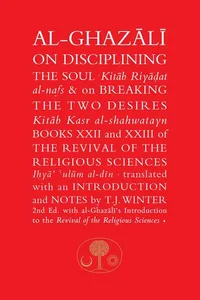
Al-Ghazali on Disciplining the Soul & on Breaking the Two Desires
'Al-Ghazali on Disciplining the Soul' is a translation of the twenty-third book of the 'Revival of the Religious Sciences' (Ihya Ulum al-Din), which is widely regarded as the greatest work of Muslim spirituality. In 'Al-Ghazali on Disciplining the Soul', Abu Hamid al-Ghazali illustrates how the spiritual life in Islam begins with `riyadat al-nafs', the inner warfare against the ego. The two chapters translated here detail the sophisticated spiritual techniques adopted by classical Islam in disciplining the soul. In Chapter One, 'Disciplining the Soul', Ghazali focuses on how the sickness of the heart may be cured and how good character traits can be acquired. In Chapter Two, 'Breaking the Two Desires', he discusses the question of gluttony and sexual desire-being the greatest of mortal vices-concluding, in the words of the Prophet, that 'the best of all matters is the middle way'. The translator, T. J. Winter, has added an introduction and notes which explore Ghazali's ability to make

The Alchemy of Happiness
2017 Reprint of 1910 Edition. Al-Ghazzali, or, Al-Ghazali, the author of The Alchemy of Happiness, was a Persian theologian, philosopher, and prolific Sunni Muslim author, and is regarded as one of the great thinkers of Islam. The work emphasized ...