


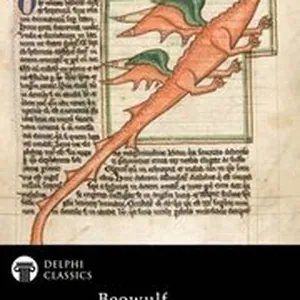
Complete Beowulf - Old English Text, Translations and Dual Text (Illustrated)
A masterpiece of Old English literature, the alliterative epic poem 'Beowulf' was written between the 8th and 11th century and narrates the eponymous hero's battles against the monster Grendel, Grendel's avenging mother and finally a terrifying dr...

Beowulf
Beowulf, composed between the seventh and tenth century, is the elegaic narrative of the adventures of Beowulf, a Scandinavian hero who saves the Danes from the seemingly invincible monster Grendel, and, later, from Grendel's mother. He returns to...

Beowulf
Composed toward the end of the first millennium,¿Beowulf is the elegiac narrative of the Scandinavian hero who saves the Danes from the seemingly invincible monster Grendel and, later, from Grendel's mother. Drawn to what he has called the "f...



Beowulf
Composed toward the end of the first millennium, Beowulf is the elegiac narrative of the adventures of Beowulf, a Scandinavian hero who saves the Danes from the seemingly invincible monster Grendel and, later, from Grendel's mother. He then returns to his own country and dies in old age in a vivid fight against a dragon. The poem is about encountering the monstrous, defeating it, and then having to live on in the exhausted aftermath. In the contours of this story, at once remote and uncannily familiar at the beginning of the twenty-first century, Nobel laureate Seamus Heaney finds a resonance that summons power to the poetry from deep beneath its surface. Drawn to what he has called the 'four-squareness of the utterance' in ?Beowulf? and its immense emotional credibility, Heaney gives these epic qualities new and convincing reality for the contemporary reader.

Beowulf
Ett av den anglosaxiga litteraturhistoriens odödliga mästerverk Beowulf, geaternas hjälte, får höra att den danske kungen Hrothgars nya kungahall plågas av ett troll vid namn Grendel. Han bestämmer sig för att hjälpa kungen och ger sig iväg. I en våldsam sammandrabbning dödar han den väldige Grendel, och natten efter dödar han även Grendels mamma som kommit för att hämnas sin son. I hennes hem hittar Beowulf ett magiskt svärd som han tar med sig hem till Geatland - i nuvarande Sverige - där det snart är hans tur att ta över kungakronan. Under många år regerar han klokt och rättvist, tills en eldsprutande drake börjar härja i riket och den åldrade hjälten åter tvingas greppa sitt svärd.Sagan om Beowulf är ett av de viktigaste och mest översatta verken skrivna på fornengelska, och det innehar en central plats i den anglosaxiska litteraturhistorien. Det är också ett av dess mest omtvistade verk, framför allt på grund av sitt dunkla ursprung. Texten har överlevt till våra dagar i ett enda pergamentmanuskript daterat till någonstans mellan 975-1025, men vem den är författad av och var berättelsen kommer ifrån är fortfarande okänt.I svensk översättning av Björn Collinder.

Beowulf, E-bok
Ett av den anglosaxiga litteraturhistoriens odödliga mästerverk Beowulf, geaternas hjälte, får höra att den danske kungen Hrothgars nya kungahall plågas av ett troll vid namn Grendel. Han bestämmer sig för att hjälpa kungen och ger sig iväg. I en våldsam sammandrabbning dödar han den väldige Grendel, och natten efter dödar han även Grendels mamma som kommit för att hämnas sin son. I hennes hem hittar Beowulf ett magiskt svärd som han tar med sig hem till Geatland - i nuvarande Sverige - där det snart är hans tur att ta över kungakronan. Under många år regerar han klokt och rättvist, tills en eldsprutande drake börjar härja i riket och den åldrade hjälten åter tvingas greppa sitt svärd. Sagan om Beowulf är ett av de viktigaste och mest översatta verken skrivna på fornengelska, och det innehar en central plats i den anglosaxiska litteraturhistorien. Det är också ett av dess mest omtvistade verk, framför allt på grund av sitt dunkla ursprung. Texten har överlevt till våra dagar i ett enda pergamentmanuskript daterat till någonstans mellan 975-1025, men vem den är författad av och var berättelsen kommer ifrån är fortfarande okänt. I svensk översättning av Björn Collinder.
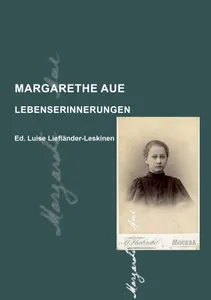
Margarethe Aue: Lebenserinnerungen, E-bok
Die Memoiren von Margarethe Aue, der Mutter des Gründers der Aue-Stiftung, Theodor Aue, werden hier zum ersten Mal im Ganzen einer interessierten Öffentlichkeit zugänglich gemacht. In der Autobiografie Margarethe Aues, einer Deutschen aus Russland, wird die Sicht einer mehrsprachigen gebildeten Frau, die schon zu Anfang des 19.Jahrhunderts als deutschsprachige Lehrerin in Moskau tätig war, deutlich. Sie wurde 1886 in Majorenhof bei Riga geboren als Tochter des Fabrikanten Theodor von Rascha und seiner Frau Sophie, geb. Zwerner. Sie hatte eine vier Jahre ältere Schwester, Ellinor. Als Margarethe neun Jahre alt war - im Jahre 1895 - zog die Familie zurück nach Moskau, wo der Vater viele Verbindungen von früher hatte. Margarethe und ihre Schwester Elli besuchten dort ein deutschsprachiges Mädchengymnasium und haben schon früh angefangen, jüngere Schüler selbst zu unterrichten und so dazu zu verdienen. Margarethe unterrichtete nach ihrem Abschluss an der eigenen Schule weiter als Vorschullehrerin, gab Privatstunden und besuchte zusätzlich abends Kurse in Psychologie, Rechtslehre und Methodik des Rechenunterrichts. Sie interessierte sich auch für die Förderung geistig behinderter Kinder und machte dazu Fortbildungskurse. Ihre Tätigkeit als Lehrerin endete im Jahre 1915, als sie Max Aue heiratete und mit ihm nach Turkestan zog. Die Söhne Theodor und Alexander Aue wurden 1916 und 1918 in Kokand geboren. Margarethe war eine Kosmopolitin schon vor ihrer Ehe, aber durch ihre Heirat hat sie auch asiatische und andere Kulturen kennengelernt. Ihr freier Blick auf die Welt, ihre Offenheit und Wertschätzung von fremden Kulturen, wie z.B. der usbekischen, kirgisischen, aber auch estnischen und lettischen und später dann finnischen, wird ganz deutlich. In Helsinki, wo die Familie Aue ab 1922 lebte, fand Margarethe Aue ein neues Zuhause. Sie war u.a. Mitglied im Vorstand der Deutschen Schule, gab aber auch Privatstunden für Schüler. Sie war aktiv tätig in der Deutschen Gemeinde, besonders im Bereich Diakonie. Nach über sechzig Jahren eines erfüllten Lebens in Finnland starb sie 1983 in Helsinki.

Beowulf- A Translation And Commentary
The translation of Beowulf by J.R.R. Tolkien was an early work, very distinctive in its mode, completed in 1926: he returned to it later to make hasty corrections, but seems never to have considered its publication. This edition is twofold, for there exists an illuminating commentary on the text of the poem by the translator himself, in the written form of a series of lectures given at Oxford in the 1930s; and from these lectures a substantial selection has been made, to form also a commentary on the translation in this book. From his creative attention to detail in these lectures there arises a sense of the immediacy and clarity of his vision. It is as if he entered into the imagined past: standing beside Beowulf and his men shaking out their mail-shirts as they beached their ship on the coast of Denmark, listening to the rising anger of Beowulf at the taunting of Unferth, or looking up in amazement at Grendel's terrible hand set under the roof of Heorot. But the commentary in this book includes also much from those lectures in which, while always anchored in the text, he expressed his wider perceptions. He looks closely at the dragon that would slay Beowulf 'snuffling in baffled rage and injured greed when he discovers the theft of the cup'; but he rebuts the notion that this is 'a mere treasure story', 'just another dragon tale'. He turns to the lines that tell of the burying of the golden things long ago, and observes that it is 'the feeling for the treasure itself, this sad history' that raises it to another level. 'The whole thing is sombre, tragic, sinister, curiously real. The "treasure" is not just some lucky wealth that will enable the finder to have a good time, or marry the princess. It is laden with history, leading back into the dark heathen ages beyond the memory of song, but not beyond the reach of imagination.' Sellic Spell, a 'marvellous tale', is a story written by Tolkien suggesting what might have been the form and style of an Old English folk-tale of Beowulf, in which there was no association with the 'historical legends' of the Northern kingdoms.
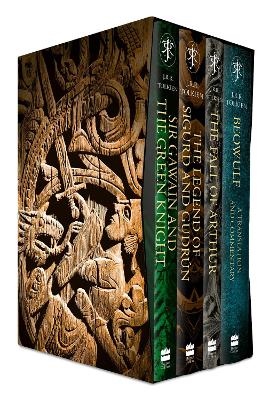
Myths And Legends (boxed Set)
Fifth in a series of hardcover boxed sets celebrating the literary achievement of Christopher Tolkien, featuring double-sided dustjackets. This slipcase contains Sir Gawain and the Green Knight, The Legend of Sigurd and Gudrun, The Fall of Arthur, and Beowulf: A Translation and Commentary. Sir Gawain and the Green Knight and Pearl are two poems by an unknown author written in about 1400. Sir Gawain is a romance, a fairy-tale for adults, full of life and colour; Pearl is apparently an elegy on the death of a child but, like Gawain, it is also a sophisticated and moving debate on much less tangible matters. Sir Orfeo is a slighter romance, belonging to an earlier and different tradition. It was a special favourite of Tolkien's. The three translations are here uniquely accompanied with the complete text of Tolkien's acclaimed 1953 W.P. Ker Memorial Lecture that he delivered on Sir Gawain. The Legend of Sigurd and Gudrun tells the epic story of the Norse hero, Sigurd, the dragon-slayer, during a time of gods, betrayal and fierce battles, the revenge of his wife, Gudrun, and the Fall of the Nibelungs. Told in verse composed by J.R.R. Tolkien derived from the ancient poetry of the Poetic Edda and the prose Voelsunga Saga, this masterful fusion of myth and poetry is accompanied by notes and commentary by Christopher Tolkien. The Fall of Arthur tells the extraordinary story of the final days of England's legendary hero, King Arthur. It is the only venture by J.R.R. Tolkien into the legends of Arthur King of Britain, and may well be regarded as his finest and most skilful achievement in the use of the Old English alliterative metre. The long narrative poem is accompanied by significant if tantalising notes, in which can be discerned clear if mysterious associations of the Arthurian conclusion with The Silmarillion. The translation of Beowulf by J.R.R. Tolkien was completed in 1926: he returned to it later but seems never to have considered its publication. This edition is twofold, for the translation is here paired with an illuminating written commentary on the poem by the translator himself, prepared for a series of lectures given at Oxford in the 1930s. From these lectures there arises a sense of the immediacy and clarity of his vision. It is as if Tolkien entered into the imagined past: standing beside Beowulf and his men shaking out their mail-shirts as they beached their ship on the coast of Denmark, listening to the rising anger of Beowulf at the taunting of Unferth, or looking up in amazement at Grendel's terrible hand set under the roof of Heorot. These are accompanied by Sellic spell, a 'marvellous tale' written by Tolkien suggesting what might have been the form and style of an Old English folk-tale of Beowulf, in which there was no association with the 'historical legends' of the Northern kingdoms. Published together for the first time, these four books - all edited by the author's son and literary executor - collect a fascinating period of Christopher Tolkien's forty-year career devoted to presenting his father J.R.R. Tolkien's scholarly writings on the myths and legends of northern Europe, a unique accomplishment that celebrates the academic brilliance and storytelling genius of one of the twentieth century's finest literary pioneers.