Learning and Innovation in Organizations and Economies
This book develops a general 'logic', or heuristic of discovery, to explain the emergence of novelty in individual thought, organizations, industries, and economies. It draws on a variety of literatures, discussing theories of organizational learn...


How Markets Work and Fail, and What to Make of Them
In this thought-provoking book, Bart Nooteboom offers a radical critique of the principal intellectual and moral assumptions underlying economic science, unravelling the notion of markets: how they work and fail, and how they may be redirected to ...

How Markets Work and Fail, and What to Make of Them
In this thought-provoking book, Bart Nooteboom offers a radical critique of the principal intellectual and moral assumptions underlying economic science, unravelling the notion of markets: how they work and fail, and how they may be redirected to ...

Inter-Firm Collaboration, Learning and Networks
Inter-firm relations are not new. But fast developments in technology and globalization have led to increased opportunities for international alliances, and an upsurge in the interest in inter-organizational relations. With the time ripe for a uni...
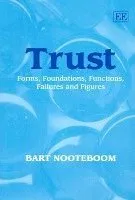
Trust
Trust is an elusive concept, meaning different things to different people, and so needs to be clearly defined. By focusing on relations within and between firms, Bart Nooteboom undertakes to produce a clearer definition of trust and its role in th...

Process Philosophy
The book analyses and compares a variety of processes of change: in evolution, learning and innovation, language and meaning, self and society and ethics and morality. Taking a realistic approach, the book is inspired by pragmatic philosophy, in particular, that of Dewey, Nietzsche, Wittgenstein, and Heidegger, and employs insights from economics, sociology, anthropology, and social psychology. The book aims to give a coherent synthesis of ideas about change and aims to see how one can take a process view of various features of humanity, such as knowledge, relations between people, language and morality, and how, vice versa, that might contribute to process philosophy.

Process Philosophy
The book analyses and compares a variety of processes of change: in evolution, learning and innovation, language and meaning, self and society and ethics and morality. Taking a realistic approach, the book is inspired by pragmatic philosophy, in p...

Cognitive Theory of the Firm
In this important and timely book, Bart Nooteboom develops and applies a social cognitive theory of firms and organizations with a focus on learning and innovation.Why explore a cognitive theory of the firm? This enlightening study explains that a...

Cognitive Theory of the Firm
In this important and timely book, Bart Nooteboom develops and applies a social cognitive theory of firms and organizations with a focus on learning and innovation.Why explore a cognitive theory of the firm? This enlightening study explains that a...




Trust Process in Organizations
Taking an interdisciplinary approach, this volume focuses on the trust processes between people within organizations, with an emphasis on empirical studies.Rational foundations and psychological motivations for trust are taken into account through...