Expanding Universe
Expanding Universe
Was ist Leben?
Zu den Büchern, die die Welt bewegten, gehört Erwin Schrödingers Meisterstück naturwissenschaftlicher Prosa »Was ist Leben?«. Die Vorlesungen des Physikers und Nobelpreisträgers sind erstmals 1944 veröffentlicht worden. In der Einführung zur Neuau...
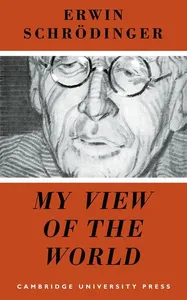
My View of the World
A Nobel prize winner, a great man and a great scientist, Erwin Schrödinger has made his mark in physics, but his eye scans a far wider horizon: here are two stimulating and discursive essays which summarize his philosophical views on the nature of...
'Nature and the Greeks' and 'Science and Humanism'
Nobel laureate Erwin Schrödinger's lectures on the history and philosophy of science are legendary. Here the texts of some of his most famous lectures are made available for the first time in many years. As Roger Penrose's foreword confirms, they ...
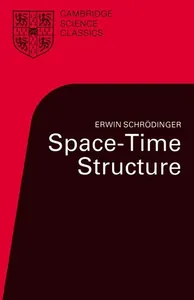
Space-Time Structure
In response to repeated requests this classic book on space-time structure by Professor Erwin Schrödinger is now available in the Cambridge Science Classics series. First published in 1950, and reprinted in 1954 and 1960, this lucid and profound e...




I Carry Your Heart with Me
I Carry Your Heart With Me is a children's adaptation of the beloved E. E. Cummings poem, beautifully illustrated by Mati Rose McDonough. Showing the strong bond of love between mother and child, within nature and throughout life, Cummings' heartf...


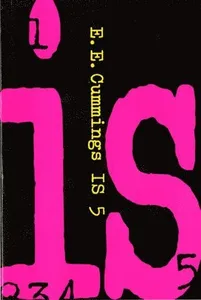
Is 5
Fresh and candid, by turns earthy, tender, defiant, and romantic, Cummings's poems celebrate the uniqueness of each individual, the need to protest the dehumanizing force of organizations, and the exuberant power of love.

95 Poems
Published in 1958, 95 Poems is the last book of new poems published in Cummings's lifetime. Remarkable for its vigor, freshness, interest in ordinary individuals, and awareness of the human life cycle, the book reflects Cummings's observations on ...
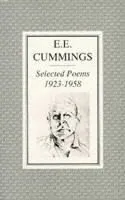
Selected Poems 1923-1958
This selection made by E.E. Cummings himself from eleven books of poems constitutes a comprehensive introduction to his work.

Tulips and Chimneys
Fresh and candid, by turns earthy, tender, defiant, and romantic, Cummings's poems celebrate the uniqueness of each individual, the need to protest the dehumanizing force of organizations, and the exuberant power of love.


Tulips & Chimneys
Edward Estlin Cummings (1894-1962), a native of Cambridge, Massachusetts, and a Harvard University graduate, is best known for his rejection of traditional poetic forms. As e. e. cummings, he conducted radical experiments with spelling, syntax, an...

73 Poems
Four months after Cummings's death in September 1962, his widow, the photographer Marion Morehouse, collected the typescripts of 29 new poems. These poems, as well as uncollected poems published only in periodicals up to that time, make up 73 Poem...
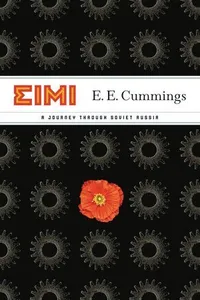
EIMI
Unavailable for more than fifty years, EIMI finally returns. While sometimes termed a "novel," it is better described as a novelistic travelogue, the diary of a trip to Russia in the 1930s during the rise of the Stalinist government. Des...


The Enormous Room
In 1917 young Edward Estlin Cummings went to France as a volunteer with a Red Cross ambulance unit on the western front. But his free-spirited, insubordinate ways soon got him tagged as a possible enemy of La Patrie, and he was summarily tossed into a French concentration camp at La Ferte-Mace in Normandy. Under the vilest conditions, Cummings found fulfillment of his ever elusive quest for freedom. The Enormous Room, his account of his four-month confinement, reads like a latter-day Pilgrim's Progress, a journey into dispossession, to a place among the most debased and deprived of human creatures. Cummings's hopeful tone reflects the essential paradox of his existence: to lose everything is to become free, and so to be saved.For more than seventy years, Penguin has been the leading publisher of classic literature in the English-speaking world. With more than 1,700 titles, Penguin Classics represents a global bookshelf of the best works throughout history and across genres and