Political Economy of Modern Capitalism
Neoliberalism and deregulation have come to dominate national and international political economy. This major book addresses this convergence and analyzes the implications for the future of capitalist diversity. It considers important questions su...

Re-Forming Capitalism
Wolfgang Streeck is a leading figure in comparative political economy and institutional theory. In this book he addresses some of the key issues in this field: the role of history in institutional analysis, the dynamics of slow institutional chang...


Taking Back Control?
The era of hyperglobalization once hailed as the 'end of history' was characterised by boundless capitalist expansion. The neoliberal revolution gave rise to a politics of scale aimed at the centralization and unification of states and state syste...

Re-Forming Capitalism
Wolfgang Streeck has written extensively on comparative political economy and institutional theory. In this book he addresses some of the key issues in this field: the role of history in institutional analysis, the dynamics of slow institutional c...

How Will Capitalism End?
In How Will Capitalism End?, the acclaimed analyst of contemporary politics and economics Wolfgang Streeck argues that the world is on the cusp of enormous change. The marriage between democracy and capitalism, ill-suited partners brought together...

How Will Capitalism End?
After years of ill health, capitalism is now in a critical condition. Growth has given way to stagnation; inequality is leading to instability; and confidence in the money economy has all but evaporated. In How Will Capitalism End?, the acclaimed ...

Critical Encounters
From the acclaimed author of How Will Capitalism End? comes an omnibus of long-form critical essays engaging with leading economists and thinkers. Critical Encounters draws on Wolfgang Streeck's inimitable writing for the London Review of Books an...

Will the gig economy prevail?
Increasingly, employees are being falsely treated as 'self-employed'. This phenomenon - the 'gig economy' - is seen as the inevitable shape of things to come. In this book, Colin Crouch takes a step back and questions this logic. He shows how the ...

Strange Non-death of Neo-liberalism
The financial crisis seemed to present a fundamental challenge to neo liberalism, the body of ideas that have constituted the political orthodoxy of most advanced economies in recent decades. Colin Crouch argues in this book that it will shrug off...

Making Capitalism Fit For Society
Capitalism is the only complex system known to us that can provide an efficient and innovative economy, but the financial crisis has brought out the pernicious side of capitalism and shown that it remains dependent on the state to rescue it from i...

Globalization Backlash
Globalization, heralded for decades as a harbinger of prosperity, faces a huge backlash. Derided by right-wing nationalists as a 'globalist' plot to undermine traditional communities, and by left-wing critics as the rule of rampaging corporations,...
Post-Democracy After the Crises
In¿Post-Democracy¿(Polity, 2004) Colin Crouch argued that behind the façade of strong institutions, democracy in many advanced societies was being hollowed out, its big events becoming empty rituals as power passed increasingly to circles of wealt...

Post-Democracy
Post-Democracy is a polemical work that goes beyond current complaints about the failings of our democracy and explores the deeper social and economic forces that account for the current malaise. Colin Crouch argues that the decline of those socia...

Chess Secrets: The Great Attackers
Colin Crouch studies his favorite attacking players, and highlights all the important themes of one of the most crucial elements of the game.

Magnus Force
In December 2012 Magnus Carlsen won the prestigious London Chess Classic and in doing so he became the highest-rated chess player in the history of the game, beating Garry Kasparov's 13-year-old record. Carlsen followed up this performance with an...

Postdemokrati
Boken Postdemokrati utkom på engelska och italienska 2004. Därefter har den översatts till spanska, kroatiska, grekiska, tyska, japanska, koreanska, ryska och nu till svenska. Med postdemokrati förstår Crouch ett politiskt system där politikerna blir alltmer inneslutna i sin egen värld och knyter an till allmänheten framför allt genom manipulationsmetoder som baserar sig på reklam och marknadsundersökningar, alltmedan demokratins yttre former tycks oförändrade. En sådan utveckling orsakas av två slags krafter: Dels förändringar i det postindustriella samhällets klasstruktur, som har skapat många nya yrkesgrupper som till skillnad från äldre grupper inte har utvecklat egna organisationer som kan företräda deras politiska intressen. Dels en enorm koncentration av makt och rikedom till de multinationella företagen, som kan utöva politiskt inflytande utan att egentligen delta i den demokratiska processen i något land men med mycket goda förutsättningar att styra den allmänna opinionen om så krävs. Crouch påstår inte att de etablerade demokratierna i Västeuropa och Nordamerika redan har gått in i en postdemokratisk period. De politiska systemen kan fortfarande alstra folkrörelser som agerar blåslampa på den politiska klassen och tvingar den att uppmärksamma deras frågor, oavsett partistrategernas och medierådgivarnas beräknande planer. Crouch menar heller inte att det postdemokratiska samhället inte längre skulle vara demokratiskt; då hade det inte varit postdemokratiskt utan odemokratiskt. Post används på samma sätt som i sammansättningen postindustriell. Det postindustriella samhället gör alltjämt bruk av alla de varor som började produceras i industrisamhället; det är bara det att innovationerna och den ekonomiska energin inte längre är inriktade på industriproduktion, utan på andra typer av verksamhet. Likadant förhåller det sig med det postdemokratiska samhället, där alla de demokratiska institutionerna består: fria val, konkurrerande partier, fri offentlig debatt, mänskliga rättigheter, en viss grad av transparens i den offentliga förvaltningen. Men politikens energi och drivkraft går tillbaka till de krafter som härskade i fördemokratisk tid, nämligen små förmögna eliter som samlar sig kring maktcentra, där de söker skaffa sig egna privilegier. Colin Crouch är professor vid universitetet i Warwick och har tidigare varit professor vid Europauniversitetet i Florens och i Oxford. »Håkan Juholt borde ha den under huvudkudden, om den inte redan ligger där.» /Lars Linder i DN »Det är en intressant skrift, dessutom väl översatt och smakfullt förpackad.» / John Lapidus i Btj


Industrial Relations and European State Traditions
In some western European countries trade unions and employers' organizations share responsibility with government for maintaining order and efficiency in the labour market as a matter of course. in others such a role is seen as an unacceptable int...

Knowledge Corrupters
In principle the advanced, market-driven world in which we now live is fuelled by knowledge, information and transparency, but in practice the processes that produce this world systematically corrupt and denigrate knowledge: this is the powerful a...

Why We Lose at Chess
The main reason why we lose at chess is no big secret: we all make unnecessary mistakes! But simply acknowledging this fact isn't enough to help us improve. The big question is, how can we eliminate these mistakes from our game, or at least keep t...

Fighting Chess: Move by Move
What separates the best chess players from the rest? What gives them the edge over their rivals? Chess legend Vladimir Kramnik believes it's their fighting skills and the ability to continuously find ways to keep a game alive. Colin Crouch agrees,...

Analyse Your Chess
Leading chess author Colin Crouch believes that the key to sustained chess improvement lies in the critical analysis and assessment of your own games. Each and every game you play provides a significant learning opportunity, and this opportunity s...

Globalisering Under Press
Knappast något begrepp i den nyare politiska historien är så omstritt som globalisering. Dagens reaktioner mot globaliseringen kommer från både höger och vänster, och det är inte alltid så lätt att urskilja vad som är vad i detta motstånd. I denna bok försöker Colin Crouch bringa reda i striden om globaliseringen. Han beskriver hur nyliberalismen utmanas på högersidan av konservativa krafter som värnar om nation och tradition, och kosmopolitismen på vänstersidan utmanas av ett värnande av nationalstaten som en förutsättning för välfärdsstaten. Crouch argumenterar för att det varken är möjligt eller önskvärt att reversera globaliseringen. Utan globaliseringen hade världen varit fattigare och de internationella relationerna mindre fredliga. Men en oreglerad globalisering är ohållbar. Globaliseringen måste räddas från sig själv genom övernationella institutioner som kan bringa marknaderna under politisk kontroll, när nationalstaterna inte kan göra det. Det krävs också nationella reformer som motverkar social ojämlikhet, främjar solidaritet och gör att städer och regioner som varit globaliseringens förlorare inte lämnas i sticket och kan återvinna sin stolthet. Ekonomisk nationalism resulterar i ett nollsummespel, den enda farbara vägen är att nationerna samfällt reglerar flödena av varor, kapital och människor. Colin Crouch är författare till den uppmärksammade boken "Postdemokrati" (2011). Han är professor emeritus i statsvetenskap vid universitetet i Warwick.
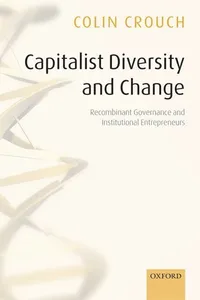
Capitalist Diversity and Change
Over the last decade the neo-institutionalist literature on comparative capitalism has developed into an influential body of work. In this book, Colin Crouch assesses this literature, and proposes a major re-orientation of the field. Crouch critiq...

The Globalization Backlash
The Globalization Backlash

The Responsible Corporation in a Global Economy
No longer only the domain of corporate public relations, corporate social responsibility (CSR) has now become a serious concern for many firms and a major sphere of academic research. However, most strikingly, by encouraging corporations to play a...

Democracy at Work
In the countries of the global North, workplace democracy may be thought of as a thing of the past. Increasingly, working relations are regulated primarily by contract; workforces are fissured and fragmented. What are the consequences of this? How...

Origins of Nonliberal Capitalism
Why was the rise of capitalism in Germany and Japan associated not with liberal institutions and democratic politics, but rather with statist controls and authoritarian rule? A stellar group of international scholars addresses this classic issue i...


Great Games by Chess Legends
Two books from the Chess Secrets series brought together in one volume. Chess Secrets is a series of books which uncover the mysteries of the most important aspects of chess: strategy, attack, classical play, opening play, endgames and preparation...

Self-Making Man
This book portrays one day in the communicative life of the owner of an auto repair-shop in Texas. He walks, looks, points, shows and explains engines, makes sense by gesture, speaks, manages, makes his life-world, and in the process reproduces so...


Citizenship, Markets, and the State
As the neo-liberal marketization of citizenship and the resulting processes of individualization proceed, debates on citizenship tend to flounder in outmoded ideological oppositions. By examining concrete cases and processes that accompany contemp...



Flirting with Space
The idea of 'flirting' with space is central to this book. Space is conceptualised as being in constant flux as we make our way through various contexts in our daily lives, and is considered in relation to encounters with complexities and flows of...