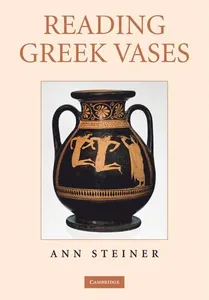
Reading Greek Vases
Repetition and symmetry are the fundamental aesthetic principles underlying the shape and decoration of ancient Athenian vases. This book is the first comprehensive study of the role of repetition beyond its aesthetic value, and as part of a code ...

Reading Greek Vases
Repetition and symmetry are the fundamental aesthetic principles underlying the shape and decoration of ancient Athenian vases. This book is the first comprehensive study of the role of repetition beyond its aesthetic value, and as part of a code ...

Litteraturen i mediesamhället
Det har aldrig sålts så mycket böcker i Sverige som nu. Men samtidigt som de flesta litterära texter fortfarande läses i bokform och sprids genom traditionella kanaler förändrar nya medier förutsättningarna för litteraturens förmedling och spridni...




Documentary Culture and the Making of Medieval English Literature
Emily Steiner describes the rich intersections between legal documents and English literature in the fourteenth and fifteenth centuries. The literature of this period, from Passion lyrics to Lollard sermons, abounds in documentary language and met...

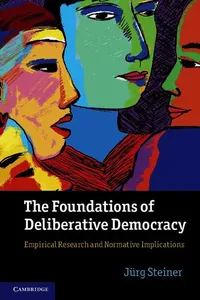
The Foundations of Deliberative Democracy
Deliberative democracy is now an influential approach to the study of democracy and political behaviour. Its key proposition is that, in politics, it is not only power that counts, but good discussions and arguments too. This book examines the int...



The Lights that Failed
The peace treaties represented an almost impossible attempt to solve the problems caused by a murderous world war. In The Lights that Failed: European International History 1919-1933, part of the Oxford History of Modern Europe series, Steiner cha...

Poetry of Thought
With his hallmark discernment, George Steiner presents in The Poetry of Thought his magnum opus, staking out his claim for the essential oneness of great thought and great style. Steiner spans the entire history of Western philosophy as it entwine...


Calendar of the Soul
In listening to the changing language of the year, said Rudolf Steiner, we can rediscover our individual nature. These meditative verses, one for each week of the year, help to awaken a feeling of unity with nature while simultaneously stimulating...

The Karma of Untruthfulness
Although these lectures were given during 1916, they have much to teach us about the political spin, media distortions, propaganda and downright lies we encounter on a daily basis in public life. Rudolf Steiner's calm and methodological approach p...
Four Temperaments
"The two streams in the human being combine to produce what is commonly known as a person's temperament. Our inner self and our inherited traits co-mingle in it. Temperament is an intermediary between what connects us to an ancestral line and...

Art as Seen in the Light of Mystery Wisdom
Within the Mystery cultures of ancient history, art, science and religion formed a unity that offered direction and spiritual nourishment to the broader society. Today, art, science and religion can again be reunited. However, as Marie Steiner ind...

Strengthening the Will
The review exercises bring the experiences of our daily lives to full awareness. By directing our attentive gaze to what has happened - whether in a single day or in whole phases of life - we kindle light in our will. Undertaking such a review bac...

Founding a Science of the Spirit
14 lectures, Stuttgart, August 22 to September 4, 1906 (CW 95) These lectures offer a fine introduction to the whole of Steiner's teaching. He speaks of the fundamental nature of the human being in relation to the cosmos, the evolution of the Eart...
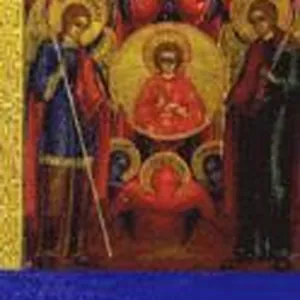
Four Seasons and the Archangels
These five profound lectures look at the cosmic forces behind the four great festivals of the year, providing a wealth of material for fruitful thought and meditation. Steiner presents great imaginative pictures that unite the heavens and the Eart...

Book of Revelation and the Work of the Priest
The Book of Revelation, or the Apocalypse, h as suffered many interpretations, mostly based on theory and speculation. In these lectures, Steiner speaks from his exp erience and knowledge of the spiritual truths in St John''s m ysterious pictures. '

Occult Physiology
Given the upsurge of interest in complementary therapies and treatments, medical researchers are gradually being pressured to reassess and expand existing knowledge about the structure and organization of the human body. But in spite of the advanc...

Background to the Gospel of St Mark
‘Christianity was bound at first to be a matter of faith and is only now beginning, very gradually, to be a matter of knowledge.’ – Rudolf Steiner Rudolf Steiner gave 70 lectures on the four canonical Gospels, characterizing the distinctive contribution of each of the evangelists. The Gospel of Mark is a ‘cosmic’ text that calls for an astronomical as well as a human reading. It is also critical for understanding the evolution of Christianity, which depends on knowledge of ‘the Mystery of Golgotha’ (Christ’s crucifixion, resurrection and ascension). ‘We are only at the beginning of Christian evolution’, Steiner states, reiterating that its further development will depend on spiritual knowledge. In order to develop such cognition, ‘most important of all is reverence for the great truths and the feeling that we can approach them only with awe and veneration’. Many profound spiritual truths are indeed revealed in these lectures. Among the panoply of topics covered are: ‘Mystery Teachings
Atlantis and Lemuria
Atlantis and Lemuria
Art as Spiritual Activity
Art as Spiritual Activity